


What are The Benefits of Tongkat Ali for Men’s Health - Backed by Research


Tongkat Ali for Men: Evidence-Informed Benefits for Hormonal Health, Energy, and Performance
Bioactive Ingredients in Tongkat Ali
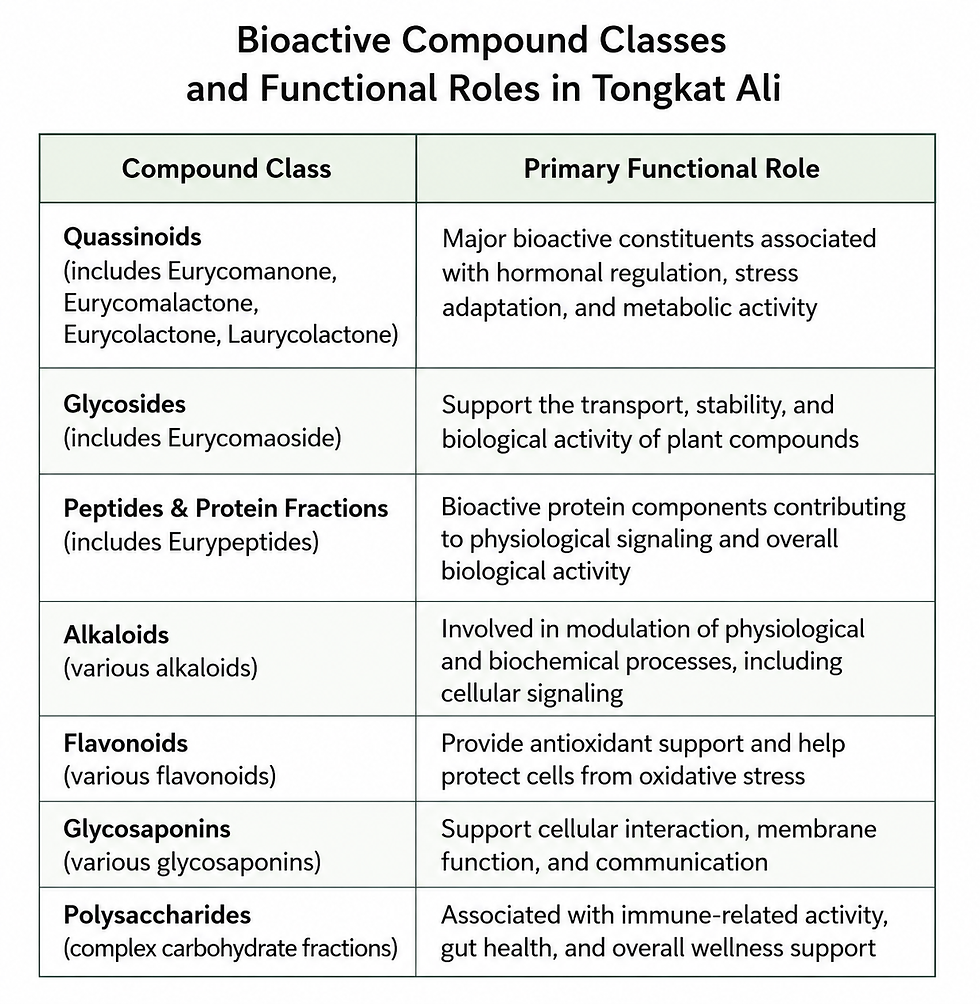
The health benefits of Tongkat Ali are attributed to a diverse range of bioactive compounds that collectively produce its pharmacological effects. Key compounds identified in Tongkat Ali include:
Eurycomalactone
Eurycomaoside
Eurycolactone
Eurycomanone
Eurypeptides
Quassinoids
Alkaloids
Flavonoids
Laurycolactone
Glycosaponins
Polysaccharides
Tongkat Ali is native to Southeast Asia and it’s a popular traditional herbal medicine used in in Malaysia and Indonesia to treat malaria, infections, fevers, male infertility, erectile dysfunction and for its aphrodisiac effects.
The wide spectrum of pharmacological effects was closely associated with various biologically active compounds of the Tongkat Ali roots, stem, leaves and even bark. However, the most potent of the Tongkat Ali plant is the root. Researchers and scientists reported that the root contains the highest bioactive ingredients that are needed to produce pharmacological responses (i.e efficacy) to our health. Most research and clinical studies in recent years are conducted using Tongkat Ali root extract to validate its health benefits.
Eurycoma Longifolia is a rich source of various classes of bioactive compounds, which includes quassinoids, alkaloids, flavonoids, eurycolactone, eurycomalactone, laurycolactone, bioactive steroids and antioxidants. Among these, bitter tasting quassinoids are the major active compound in the roots.
Many herbalists regard the root as an adaptogen. An adaptogen is a herb that helps the body adapt to different kinds of stress, including physical, chemical, and biological stress while antioxidants are compounds that fight cellular damage caused by molecules called free radicals.

Traditionally, the water decoction of Eurycoma Longifolia root is consumed. Nowadays, more convenient formulas are available, Tongkat Ali extract mixed with teas and coffees, and many products that are available either in the form of raw crude root powder or as capsules mixed with other herbs in the health-food market.

Due to the many traditional and scientific benefits, many Eurycoma Longifolia products are registered with the National Pharmaceutical Control Bureau of Malaysia (NPCB, 2016) due to the high demand. It is now currently sold as a Traditional Herbal Medicine in Malaysia.
According to a 2016 study, animal and human studies suggest that the beneficial effects may include:

1. Increasing Testosterone Levels
Tongkat Ali’s potential to increase testosterone in men with low levels of this primary sex hormone is well known and well documented.
Low testosterone can result from aging, chemotherapy, radiation treatments, some medications, injury or infection of the testicles, and certain diseases, such as chronic alcoholism and obstructive sleep apnea.
Tongkat Ali might also be able to restore testosterone levels among people with testosterone deficiency syndrome, or late-onset hypogonadism. Some researchers say this suggests the supplement could be an alternative to testosterone replacement therapy, a typical treatment for men whose bodies do not produce enough testosterone.
Effects of inadequate testosterone levels include low libido, erectile dysfunction, and in some cases, infertility. Since compounds in Tongkat Ali may boost low testosterone, it could treat these issues.
A 1-month study in 76 older men with low testosterone found that taking 200mg of Tongkat Ali extract per day significantly increased levels of this hormone to normal values in over 90% of participants.
What’s more, studies in both animals and humans show that taking Tongkat Ali stimulates sexual arousal and may improve erectile dysfunction in men.

2. Increasing Sex Drive
Tongkat Ali’s ability to stimulate sexual desire is one of its main uses and evidence seems to support this benefit, with research showing that supplementing with Tongkat Ali can increase libido, or your sex drive.
A 2019 study in rats suggested that the aphrodisiac effects of Eurycoma Longifolia may be due to the elevation of testosterone levels and enhancement of dopamine in the brain.
3. Improving Erectile Function
Research has shown that Tongkat Ali may improve overall erectile function. Men who took 300mg of a Tongkat Ali extract per day for 12 weeks reported improvements in their erections compared to those who took a placebo. This includes improvement on how often they were able to get an erection during sexual activity.
4. Improving Male Fertility
Research has shown that Tongkat Ali may improve semen volume as well as how well semen move, sperm motility and concentration, boosting male fertility.
One study in 75 male partners of couples with infertility found that taking 200mg of Tongkat Ali extract per day significantly improved sperm concentration and motility after 3 months. The treatment helped over 14% of couples become pregnant.
Similarly, a 12-week study in 109 men ages 30–55 observed that taking 300mg of Tongkat Ali extract daily increased sperm volume and motility by an average of 18% and 44%, respectively.
5. Increasing Strength and Endurance
Athletes sometimes use ergogenic aids to enhance their performance. Ergogenic aids are substances aimed at enhancing physical performance and energy production during athletic activity providing athletes with a competitive advantage.
Tongkat Ali may act as an ergogenic aid because it decreases stress and increases testosterone levels, according to one 2016 Study.
The researchers concluded that with high dosages and long-term supplementation, Eurycoma Longifolia have some benefit in relation to endurance performance.
In a small 2016 study, young men who took Tongkat Ali had significant improvements in their peak power when completing a resistance training program.
In other words, the supplement acts as an ergogenic aid, which is a substance that can enhance physical performance and improve body composition.
6. Improving Muscle Mass
A 2014 Study in physically active people aged 57–72 years reported enhanced muscle strength and increases in testosterone following supplementation with Eurycoma Longifolia extract for 5 weeks.
Tongkat Ali is often claimed to boost athletic performance and increase muscle mass. This is because it contains compounds called quassinoids, including eurycomaoside, eurycolactone, and eurycomanone, which may help your body use energy more efficiently, reduce fatigue, and improve endurance.
As part of traditional medicine, people have consumed the root extract of Tongkat Ali as a way to get stronger. Research seems to back up this usage, with some data showing that taking a Tongkat Ali supplement can increase muscle strength and size.
A small, 5-week study in 14 men participating in a strength training program found that those who took 100mg of Tongkat Ali extract per day experienced significantly greater increases in lean body mass than those taking a placebo.
They also lost more fat than participants in the placebo group.
What’s more, a 5-week study in 25 active older adults discovered that supplementing with 400mg of Tongkat Ali extract daily significantly increased muscular strength, compared to a placebo.
7. Help Combat Certain Cancers
A 2014 study are discovering and identifying new quassinoids in Eurycoma Longifolia that may help fight cancer, experimentation in test tubes indicate that the compounds are toxic to lung and cervical cancer cells.
A review from 2018 study identified 16 compounds in Eurycoma Longifolia, isolated from various parts of the plant, that showed promising anticancer properties.
Another 2015 study indicated that quassinoids from Eurycoma Longifolia were effective against human prostate cancer cells.
8. Promote Anti-Inflammatory and Antimicrobial Effects
Research in a 2016 study indicates that Eurycoma Longifolia is effective against bacteria, including Escherichia Coli and Salmonella Typhi.
In test tube studies, extracts of the plant showed anti-inflammatory and antioxidant properties.
9. Help Relieve Stress & Elevates Moods
A study in the Journal of the International Society of Sports Nutrition, assessed stress hormones in 63 people taking Tongkat Ali extract or a placebo for 4 weeks.
The researchers saw significant improvements in anger, tension, and confusion in people taking the extract. Testosterone levels increased, and levels of the stress hormone cortisol decreased.
Tongkat Ali may lower stress hormones in your body, decrease anxiety, and improve moods.
A 1999 study first identified the possible role of this remedy in treating mood issues and found that Tongkat Ali extract was comparable to a common anti-anxiety medication in reducing symptoms of anxiety in mice.
A 1-month study in 63 adults with moderate stress found that supplementing with 200mg of Tongkat Ali extract per day reduced levels of the stress hormone cortisol in saliva by 16%, compared to those who received a placebo.
Participants also reported significantly less stress, anger, and tension after taking Tongkat Ali.
They concluded that Tongkat Ali might be an effective remedy for modern-day chronic stress, sleep deprivation, and exercise training.
Another research looked at the combined effects of Eurycoma Longifolia and multivitamins in moderately stressed but otherwise healthy participants. The participants reported enhanced vigor and emotional well-being. Glucose concentrations also decreased, which may also have contributed to the participants’ well-being.
Supplementing with Tongkat Ali may reduce stress and improve mood. One study involved 86 people who said they had moderate stress from working and trying to maintain a work-life balance. For 12 weeks, some of the participants received a combination of a Tongkat Ali supplement and multivitamins while others received a placebo. At the end of the study period, those who took the supplement said they felt more energized and emotionally better. They reported feeling calmer and more at peace.
Possible Side Effects and Dosage
A research on the safety and toxicity of Eurycoma Longifolia reported that it does not seem to have detrimental effects on sperm in test tubes when the scientists used it in therapeutic doses. However, animal studies show that in higher concentrations, it may be toxic.
The same review concluded that scientists consider Eurycoma Longifolia safe as long as people do not take it in high doses. The authors recommend taking 200–400 milligrams daily with caution, especially if the person is an older adult.

People who have hormonal cancers should be cautious of taking Eurycoma Longifolia, as it may increase testosterone levels. Although laboratory studies have indicated beneficial effects, these effects may not be the same in the human body.
People taking medications to lower their blood glucose should speak to their doctor before taking Eurycoma Longifolia, as it may increase the effects of these medications.
According to the review, some sources advise people with certain conditions to avoid Eurycoma Longifolia. These conditions include cancer, heart disease, and kidney disease. People with weakened immune systems should also be cautious.
According to a 2021 report by the European Food Safety Authority (EFSA) Panel on Nutrition, Novel Foods and Food Allergens, a high dose (2,000mg/kg body weight) of the water-based extract from dried ground Tongkat Ali may lead to DNA damage of stomach and duodenum tissues.
However, in separate studies on the use of Tongkat Ali in humans, however, have not reported any side effects. A 2016 review that included toxicology studies found that mice did not experience changes in their liver or kidney function when they were orally given 2000mg/kg body weight of Tongkat Ali in an alcohol-based extract or 3000mg/kg in a water-based extract.
One 2012 study of 109 men between the ages of 30 and 55 noted that taking 300mg of Tongkat Ali extract daily over a 12-week period was as safe as taking a placebo.
Other studies suggest that taking up to 1.2 grams of Tongkat Ali extract per day is safe for adults, but this amount has not been used in research. The effects of Tongkat Ali in children or pregnant and breastfeeding women have not been researched. Therefore, it’s unknown whether the remedy is safe for these group of people.
Conclusion
Tongkat Ali is a botanically and pharmacologically complex herb with a long history of traditional use and a growing body of scientific research. Its root-derived bioactive compounds, particularly quassinoids, underpin its wide range of observed biological effects. When sourced responsibly and used within studied dosage ranges, Tongkat Ali remains one of Southeast Asia’s most scientifically investigated traditional herbs.
Peer-Reviewed Citations
Bhat, R., Karim, A. A. (2010).Tongkat Ali (Eurycoma longifolia Jack): A review on its ethnobotany and pharmacological importance.Fitoterapia, 81(7), 669–679
Rehman, S. U., Choe, K., Yoo, H. H. (2016).Review on a traditional herbal medicine, Eurycoma longifolia Jack (Tongkat Ali): Traditional uses, chemistry, evidence-based pharmacology and toxicology.Molecules, 21(3), 331
Low, B. S., Das, P. K., Chan, K. L. (2013).Standardized quassinoids composition of Eurycoma longifolia extract and its pharmacological effects.Journal of Ethnopharmacology, 145(3), 706–714
Ismail, S. B., Wan Mohammad, W. M. Z., George, A., et al. (2012).Randomized clinical trial on the use of Eurycoma longifolia Jack for the treatment of male androgen deficiency.Andrologia, 44(S1), 309–316
Tambi, M. I. B. M., Imran, M. K. (2010).Eurycoma longifolia Jack in managing idiopathic male infertility.Asian Journal of Andrology, 12(3), 376–380
Talbott, S. M., Talbott, J. A., George, A., Pugh, M. (2013).Effect of Tongkat Ali on stress hormones and psychological mood state in moderately stressed subjects.Journal of the International Society of Sports Nutrition, 10, 28
Hamzah, S., Yusof, A. (2003).The ergogenic effects of Eurycoma longifolia Jack: A pilot study.British Journal of Sports Medicine, 37(5), 465–466
Chan, K. L., Low, B. S., Teo, S. L. (2015).Safety assessment of Eurycoma longifolia extract: Acute and subacute toxicity studies. Food and Chemical Toxicology, 76, 178–186
Kuo, P. C., Damu, A. G., Lee, K. H., Wu, T. S. (2004).Cytotoxic and antimalarial constituents from the roots of Eurycoma longifolia.Journal of Natural Products, 67(12), 2061–2064
Chen, Y., Xu, J., Zhang, Y., et al. (2014).Quassinoids from Eurycoma longifolia and their cytotoxic activities.Bioorganic & Medicinal Chemistry Letters, 24(19), 4494–4498
Wahab, N. A., Mokhtar, N. M., Halim, W. N. H. A. (2018).Antioxidant and anti-inflammatory activities of Eurycoma longifolia extracts.Journal of Herbal Medicine, 13, 1–7
European Food Safety Authority (EFSA) Panel on Nutrition, Novel Foods and Food Allergens. (2021).Safety of water-based extract of Eurycoma longifolia Jack as a novel food.EFSA Journal, 19(3), e06527
This article is intended for educational purposes and reflects an evidence-informed overview integrating traditional knowledge with modern research.
What are The Benefits of Tongkat Ali for Men’s Health - Backed by Research


Comments